Think about the drawer at home filled with old chargers and cables. One fits a camera. Another belongs to a speaker you probably do not even own anymore. The one you need? Somehow missing.
For years, AI integrations created the same kind of mess. Every AI application needed custom code for every external system it wanted to use. The math gets painful quickly.
Where the N × M problem comes from
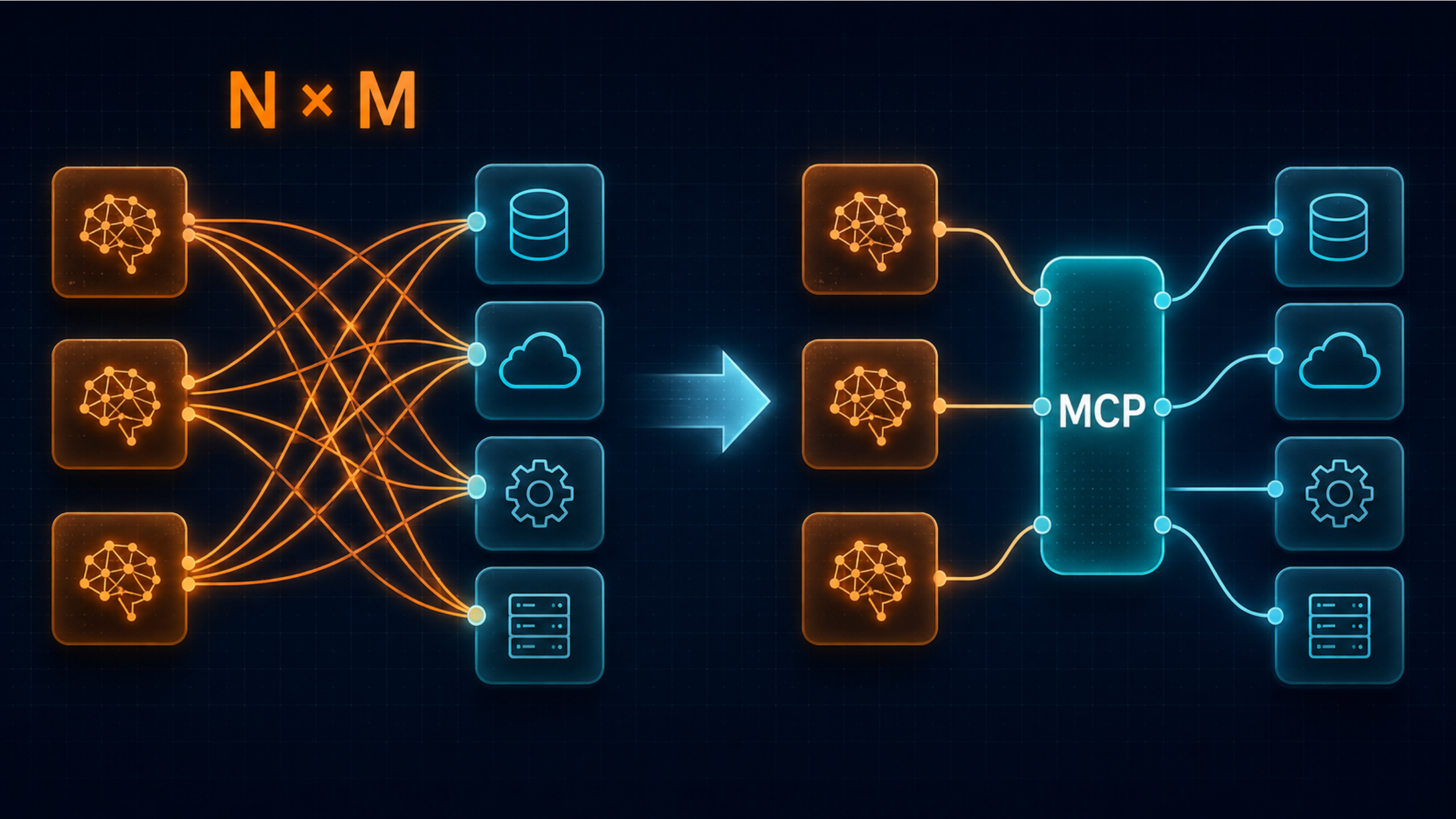
I usually explain this using an example of three AI applications (or agents) and four unique systems: GitHub, Slack, Jira, and PostgreSQL. Without a shared protocol, every application needs its own custom connector to connect to each of those systems.
3 AI applications × 4 systems = 12 custom integrations
Each connector translates requests, returns data in the expected format, and handles access to the underlying system. Even across multiple agents, the GitHub connectors might still be completely different.
Adding a fifth system (or tool) can mean three more connectors, one for each application. A fourth AI application requires four more connectors. Scale that to 10 AI applications and 50 systems, and you are looking at as many as 500 custom pairings to build and maintain.
It just doesn't scale. That is the N × M problem.
How MCP changes the integration model
The Model Context Protocol gives both sides a shared way to communicate. An AI application, called a host in MCP, supports the protocol and manages a client for each server it uses. The MCP server exposes an external system through that same protocol.
For this example, shared protocol support drops the implementation count to seven.
3 AI applications + 4 MCP servers = 7 standard implementations
Here, seven counts implementations of the shared protocol. The [official MCP architecture](https://modelcontextprotocol.io/specification/2026-07-28/architecture) uses a one-to-one relationship between a client and a server. In a fully connected 3-by-4 setup, all 12 client-server relationships can still exist at runtime. The savings come from reusable integration code.
The MCP server handles the system-specific work. A GitHub server understands GitHub's API and might expose tools for searching repositories or opening an issue. A PostgreSQL server could offer a read-only query tool. Through the [standard MCP server interface](https://modelcontextprotocol.io/specification/2026-07-28/server), servers can also expose resources and prompt templates.
At 10 AI applications and 50 external systems, the same model now only requires about 60 implementations.
10 AI applications + 50 MCP servers = about 60 standard implementations. The reuse removes hundreds of one-off adapters from the design.
The USB-C comparison
USB-C gave hardware makers a common connector. The charger still handles power, and the device still has its own electronics, but both sides agree on how they connect.
MCP follows the same basic idea. The server still has to understand the underlying API, authentication model, and permissions. The AI application only needs to speak MCP.
Build the integration once, then connect it to other applications that speak the same standard.
A quick security note
You should always treat MCP servers as integration code. They can reach sensitive data and take actions against your system. Use narrow permissions and require approval for operations that could change or delete something. Or better yet, look at using OAuth to secure your MCP servers.
The host controls what reaches a server and how tool calls are presented to the user. Access to the underlying system remains with the server deployment.
Final thoughts
MCP gives AI applications a reusable integration model. Once a GitHub MCP server exists, compatible hosts can reuse it instead of starting another GitHub-specific connector from scratch.
At 10 AI applications and 50 systems, the planning model moves from as many as 500 custom pairings toward about 60 standard implementations. That reduction in repeated connector code is why MCP servers matter.